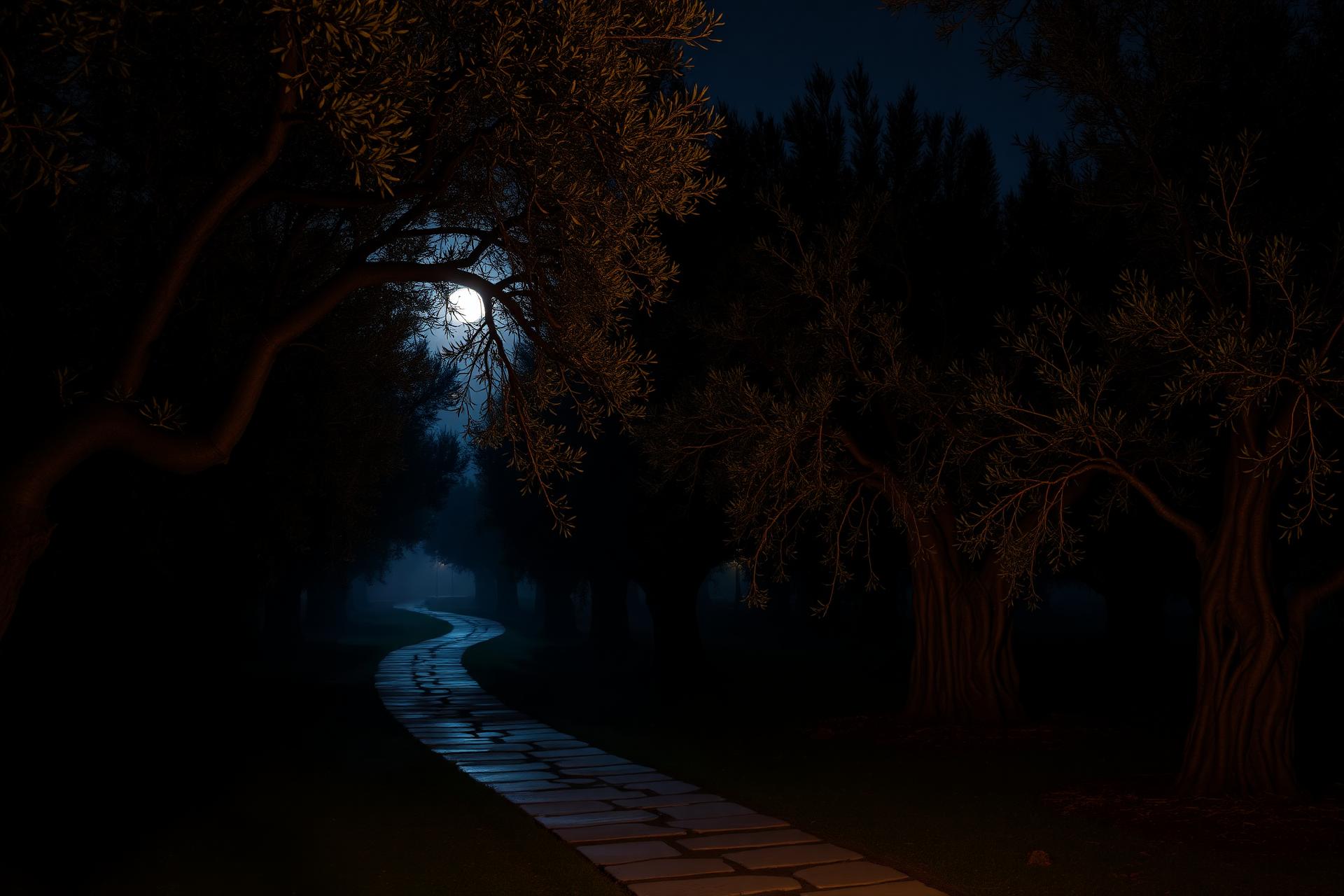
Before Gethsemane was a story, it was a name. And the name tells you everything: an olive press — a place where something precious is drawn out only under crushing weight.
Part One
The Name: An Olive Press
Gethsemane is not a Hebrew word for "garden." It comes from the Aramaic gat shemanim — literally, an olive press. Long before the night the Gospels remember, this grove at the base of the Mount of Olives was a working place: stone basins where harvested olives were crushed and pressed until the oil finally ran out.
In Scripture, oil is never a small thing. It anointed kings and priests, fed lamps through the night, and marked the presence of the Holy Spirit. Oil only comes from olives that are broken. The name Gethsemane quietly announces the theme before the story even begins: the crushing that comes before the light.
Part Two
The Place: Across the Valley from Jerusalem
The garden lay just outside Jerusalem's eastern wall, across the Kidron Valley, on the lower slopes of the Mount of Olives. The Temple mount rose in full view. When Jesus and His disciples crossed the valley after the Passover meal, they were walking a path their ancestors knew well — away from the crowds, into a familiar grove of ancient olive trees.
The olive trees that stand there today are among the oldest living things in the region; some are believed to be centuries old, descendants of the trees that would have shaded the garden. It was a place of routine and rest — the place Jesus went when, as Luke records, He customarily went out to the Mount of Olives (Luke 22:39). The most famous night in history unfolded in a spot chosen for its quiet.
Part Three
The Night: Agony, Prayer, and Surrender
The Gospels of Matthew, Mark, and Luke each record what happened there. Jesus withdrew a stone's throw from His sleeping disciples, fell to the ground, and prayed with a grief so raw that He said, "My soul is overwhelmed to the point of death" (Matthew 26:38). Luke, the physician, adds a detail only he records: His sweat was like drops of blood falling to the ground (Luke 22:44).
His prayer is the shortest and most honest in Scripture. First the request: "Father, if You are willing, take this cup from Me." Then the surrender: "Yet not my will, but Yours be done" (Luke 22:42). The two lines sit side by side. Gethsemane does not hide the plea — it holds it together with the yielding. That is the whole grammar of biblical surrender: honest desire, offered open hands.
Then the steps arrive. Judas appears with soldiers and religious leaders and betrays Jesus with a kiss. The disciples scatter. The garden that had been a place of prayer becomes a place of arrest — and the surrender made in the olive grove carries Him through everything that follows.
Part Four
The Meaning: Why Gethsemane Became a Symbol
For two thousand years, believers have returned to Gethsemane because it names something universal. Everyone eventually arrives at a garden — a season when strength runs out, prayers seem to hang in the air unanswered, and the only options left are resistance or surrender.
The olive press makes the metaphor exact. Olives do not release their oil until they are crushed under weight. Scripture's most enduring images of light — anointing oil, the lamps that burned through the night — begin with that pressing. Gethsemane teaches that the pressure itself is not the end of the story; it is where the oil is drawn out.
And Gethsemane reframes what surrender means. Jesus did not surrender because He had stopped caring; He asked for the cup to pass, and then He trusted the Father with the answer. Biblical surrender is not resignation. It is honesty plus trust — "not my will, but Yours" — spoken from the floor, in the dark, before anything has been resolved.
That is why the Garden has become shorthand in Christian writing and prayer for the decisive inner moment: the battle fought not against circumstances, but between our will and God's. No resurrection happens without a Gethsemane first.
“Father, if You are willing, take this cup from Me; yet not My will, but Yours be done.”
Luke 22:42
Questions
About the Garden of Gethsemane
- What does the word Gethsemane mean?
- Gethsemane comes from the Aramaic gat shemanim, which means "olive press." The garden was an olive grove on the Mount of Olives where oil was pressed from harvested olives. The name has come to symbolize a place of intense pressure, prayer, and surrender to God.
- Where is the Garden of Gethsemane?
- The Garden of Gethsemane sits at the base of the Mount of Olives in Jerusalem, just across the Kidron Valley from the city's eastern wall. It was a familiar stopping place for Jesus and His disciples during their visits to Jerusalem.
- What happened in the Garden of Gethsemane in the Bible?
- On the night before His crucifixion, Jesus prayed in the Garden of Gethsemane while His disciples slept. He asked the Father to let the cup pass from Him, yet surrendered His will — "not my will, but Yours be done" (Luke 22:42). Shortly after, Judas arrived and betrayed Him with a kiss.
- Why is Gethsemane a symbol of suffering and surrender?
- Just as olives are crushed under a press to release their oil, Gethsemane marks the moment Jesus was pressed by grief and anguish — yet chose to trust the Father rather than resist. The garden stands for every season when our strength runs out and surrender becomes the only way forward.
From the Garden to Your Season
A garden you have walked through too.
The Garden of Gethsemane walks with readers through pain, betrayal, silence, wrestling, grace, and hope — fourteen chapters built around one conviction: the garden is not where the story ends. It is where resurrection begins.